



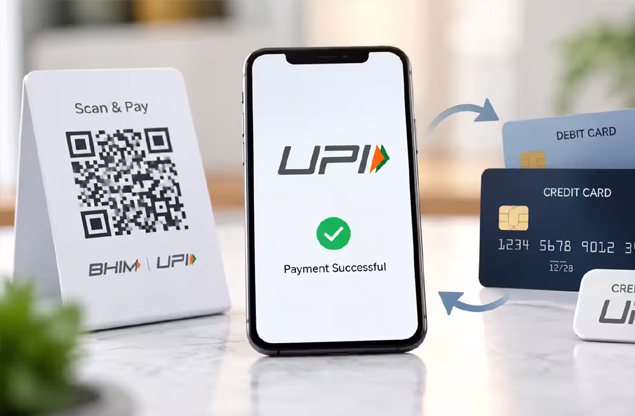
India’s Unified Payments Interface (UPI) is set to enter a new phase from October 15, with the introduction of a Merchant Discount Rate (MDR) on certain high-value merchant transactions. The change will alter how the cost of processing UPI payments is shared across the digital-payment ecosystem.
Under the new framework, a 0.4% MDR will apply to specified person-to-merchant UPI transactions above ₹2,000, subject to a maximum charge of ₹300 per transaction. The charge will be borne by the merchant rather than being directly deducted from the customer’s bank account.
For example, if a customer makes a ₹3,000 UPI payment to a merchant, the MDR would be ₹12. For a ₹50,000 transaction, it would be ₹200. Once the transaction reaches ₹75,000, the charge reaches the maximum limit of ₹300.
Who paid for UPI until now?
UPI has operated for several years under a zero-MDR model for most transactions. The cost of running the system—including payment infrastructure, technology, cybersecurity, fraud prevention and other operational requirements—has been supported through the wider banking and payments ecosystem, along with government financial support.
As UPI transaction volumes have expanded sharply, the new MDR framework is intended to create a revenue mechanism within the payment ecosystem and reduce reliance on government support.
Will customers have to pay?
For consumers, the immediate answer is no. The new MDR is a merchant-side charge. Customers will continue to make ordinary UPI payments without a separate transaction fee.
Person-to-person transfers will remain free, while merchant transactions up to ₹2,000 will also remain outside the standard MDR framework.
Small merchants meeting the prescribed eligibility conditions will also continue to receive zero-MDR benefits.
How much money could the new system generate?
The introduction of the 0.4% MDR could create a substantial new revenue stream for banks, payment companies and other participants in the UPI ecosystem. Industry estimates have placed the potential annual revenue in the ₹16,000–₹17,000 crore range, although the final amount will depend on transaction volumes, exemptions and the eventual distribution mechanism.
The revenue is expected to support areas such as payment infrastructure, cybersecurity, technology development and expansion of digital-payment services.
Who benefits from the change?
Banks, payment service providers and other participants involved in processing UPI transactions are expected to receive revenue under the new system. At the same time, consumers retain free access to UPI for ordinary payments, while smaller merchants receive exemptions designed to protect low-value businesses.
The new system therefore changes who bears the cost of selected UPI transactions, rather than introducing a general charge on UPI users.
For the average consumer, scanning a QR code and paying through UPI will continue to be free. The major change will be on the merchant side, particularly for larger person-to-merchant transactions beginning October 15.


